Community
Habitat for Humanity: The House Payment That Builds the Next House
How a no-profit, no-interest model born on a Georgia farm grew into one of the world's best-known homebuilders.
By The Pennygood team · Jun 2026 · 3 min read
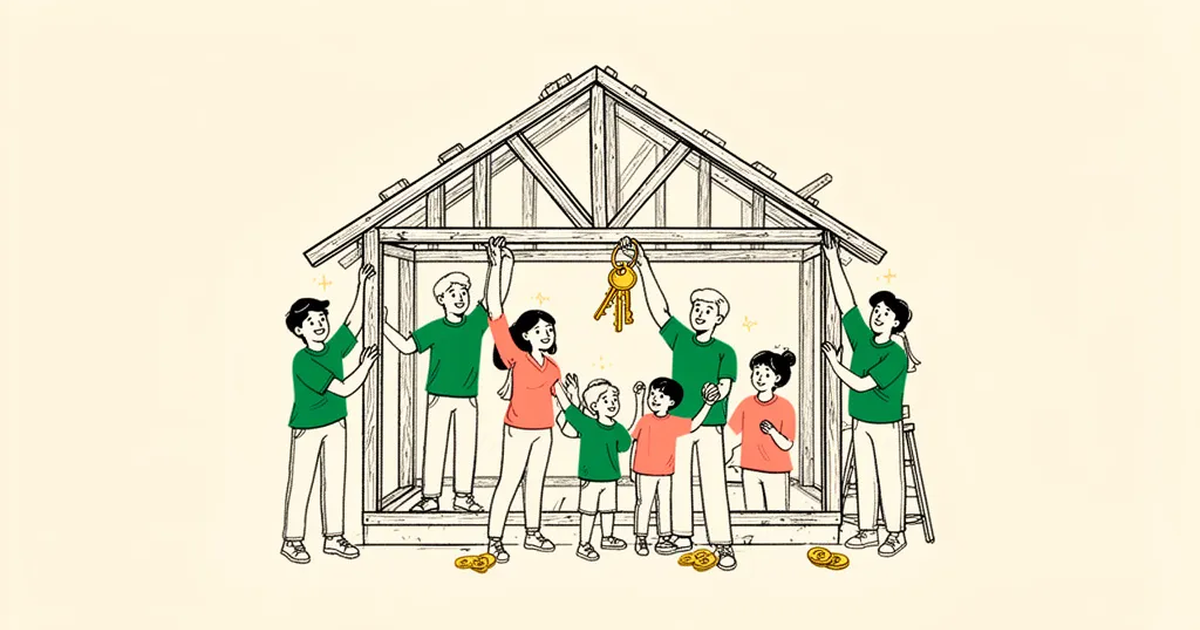
Pay your mortgage to most lenders and the money vanishes into a bank. Pay it to Habitat for Humanity and it does something stranger: it helps put up the next family's house. That loop — a payment that turns back into a wall — has been the engine behind Habitat since the beginning.
An idea that started on a Georgia farm
Habitat's roots run back to Koinonia Farm, a small community near Americus, Georgia, founded by the farmer and biblical scholar Clarence Jordan. There, Jordan together with Millard and Linda Fuller worked out a concept they called partnership housing: families who needed a decent home would build alongside volunteers, and the houses would go up at no profit.
To pay for it, they created the Fund for Humanity. New homeowners' payments were pooled with no-interest loans from supporters and money raised through fundraising, and that pool paid to build more homes. In 1973 the Fullers carried the idea to Zaire — today the Democratic Republic of Congo — and in 1976 they founded Habitat for Humanity International back in Americus, where it is still headquartered.
Sweat equity, not a handout
Habitat homes are not given away. Families accepted into the program put in 'sweat equity' — hours spent helping to build their own house or someone else's, taking homeownership and budgeting classes, or pitching in at a Habitat ReStore. They then buy the finished home with an affordable mortgage, which Habitat works to keep at no more than about 30% of a household's income. And, just as on that first Georgia farm, those payments cycle back to fund the next build.
From one wall to roughly seventy countries
From that single experiment, Habitat now works in all 50 U.S. states and approximately 70 countries. Building new homes is only part of the picture: the organization repairs homes so older adults can age in place, helps revitalize struggling neighborhoods, responds after disasters, and pushes for better housing policy through advocacy. The throughline is its stated vision — a world where everyone has a decent place to live — and the argument that stable housing supports better health, education, and economic footing.
When a president picked up a hammer
Habitat's profile grew sharply in 1984, when former U.S. President Jimmy Carter and former First Lady Rosalynn Carter joined a build in New York City. What became the annual Jimmy & Rosalynn Carter Work Project drew volunteers for decades; its 2024 edition marked the project's 40th anniversary and put up 30 new homes in a single week.
Habitat works through hundreds of local affiliates, so the most direct way to help is usually close to home — volunteering on a build, shopping or donating goods at a nearby ReStore, or giving through the organization's own site at habitat.org.
A build like this only happens because individuals show up: the regular volunteer swinging a hammer on a Saturday, the neighbor who rallies the crew. Pennygood is a platform made for exactly those people — a way for a community to send someone who does steady good a little monthly support. If that brings someone to mind, they can start a page at pennygood.me.