Community
World Wildlife Fund's Alaska Work Starts With Someone Pointing at a Map
Inside WWF's Arctic Community Wildlife Grants — capped near $25,000 — and the beluga project in the Yukon Delta that showed why small, locally led money works.
By The Pennygood team · Aug 2026 · 6 min read
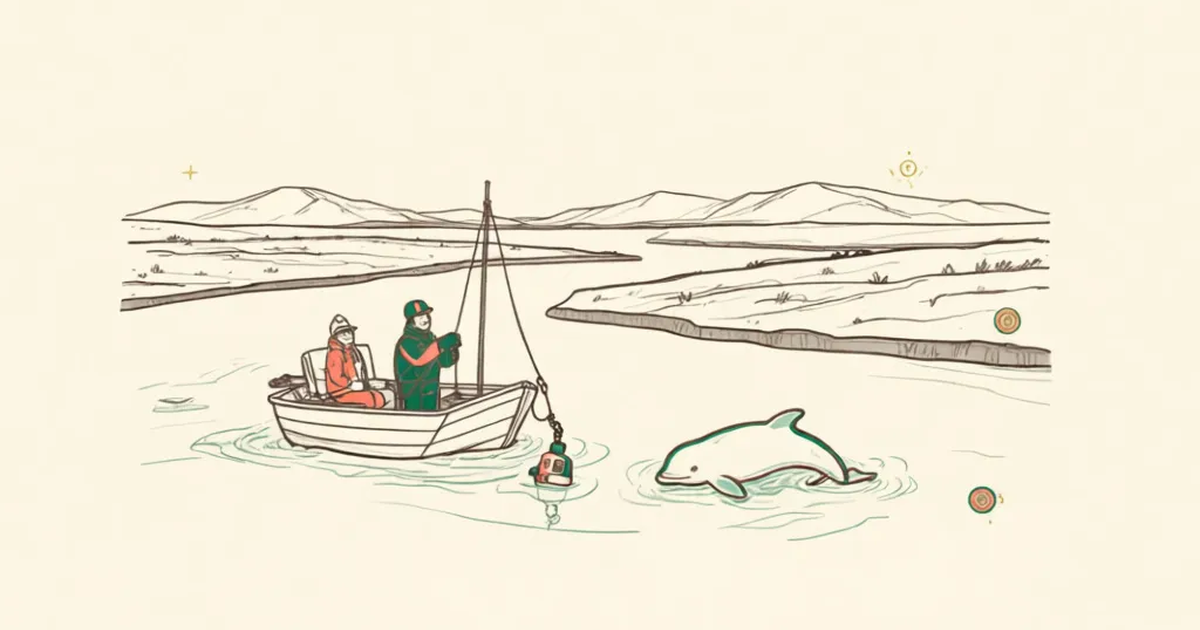
At a 2022 meeting of the Alaska Beluga Whale Committee — a co-management body made up of Indigenous hunters, wildlife managers and scientists — researchers presented their population estimates for beluga whales in the Eastern Bering Sea and put up a map of the water they had surveyed. Duncan Okitkun, a young Alaska Native hunter there as a delegate, noticed the surveyed area stopped short of the river. He had seen belugas gather there. The counts, he said, were probably missing animals in the Yukon Delta.
He brought a fix with him too: put acoustic recorders in the Yukon River and listen for the whales, with local help to get the equipment where it needed to go.
Two listening stations in the Yukon River
With a grant from World Wildlife Fund, committee delegates from the villages of Kotlik and Emmonak partnered with Manuel Castellote, an acoustician affiliated with NOAA Fisheries and the University of Washington. The pilot returned results inside a year. Belugas were detected in summer and fall, moving through the delta system; two listening stations recorded their presence. That evidence goes straight back into how subsistence hunting is co-managed.
Belugas are a food source and a cultural anchor for Yup'ik communities in the Yukon-Kuskokwim Delta, and finding them is a trained skill rather than a matter of looking. John Unok, a hunter and Yup'ik culture teacher in Kotlik, describes bringing people out to sea who see nothing at all where he sees a whale. "You just see the ripples," he says — knowledge that has to be handed down or quietly lost.
Grants of about $25,000, reviewed four times a year
The beluga work became a template. WWF now runs an Arctic Community Wildlife Grants program that funds conservation, stewardship and research on coastal Arctic ecology and priority species — polar bears, walrus, ice seals, belugas, bowhead whales and Arctic seabirds — in the Bering, Chukchi and Beaufort Seas and the coastline around them. Grants run to roughly $25,000 per project per year, and projects are meant to last about a year. Applications are accepted on a rolling basis and reviewed quarterly.
One detail says more about the program than the money does. WWF opened it to community groups, Tribal councils, co-management bodies, governments, universities, independent research outfits and nonprofits alike, and rebuilt the application so that having written grant proposals before would not be a limiting factor — with more than one way to submit, to fit different ways of communicating. In a field where funding tends to reach whoever can write like a foundation officer, that is a deliberate choice about who gets to be funded.
The rest of the Alaska list
The grants sit alongside other work in the state, most of it downstream of one number: WWF describes the Arctic as warming nearly four times faster than the rest of the planet, with the communities living there absorbing the consequences first.
- Polar bears: with sea ice forming later and breaking up earlier, bears spend more time near Bering Strait villages. WWF funds deterrence plans developed with the Indigenous-led Alaska Nannut Co-Management Council.
- Shipping: the Bering Strait hosts over a million marine mammals, and thinning ice is opening new channels through it. WWF and the Arctic Watch program broadcast alerts to vessels about critical habitat and speed measures.
- Shorebirds: at Paimiut and Hooper Bay, community members pair Indigenous knowledge with radio telemetry to track birds whose Yukon-Kuskokwim Delta habitat is eroding out from under them.
- Young people: WWF has taken part in the Sitka Sound Science Center's Scientists in the School program since 2021, co-leads a seabird camp on St. Paul Island, supports the Arctic Youth Ambassador program, and started a science camp in the Native Village of Savoonga in 2025.
- Walrus ivory: WWF backed the ARTIST Act, which protects Alaska Native artists' right to make and sell authentic walrus ivory handicrafts. The US Senate passed it in October 2025.
Five projects, $33,500, and a panda
There is an old version of this. WWF was conceived in April 1961 and set up shop that September in Morges, Switzerland; the US organization was incorporated in Washington, DC on 1 December 1961, with Ira N. Gabrielson as its first president. The giant panda became the logo the same year. In its first year the board approved five projects totalling $33,500 — the bald eagle, a Hawaiian seabird, the giant grebe of Guatemala, the Tule goose in Canada, the red wolf in the southern United States. It began as a way to move modest sums to people already doing the work.
The sums are no longer modest. For the year ending 30 June 2025, WWF reported $395 million in program spending, including a record $258 million on conservation programs and policy, and says 83% of what it spends goes to conservation. Individual donors accounted for $144 million of that year's operating revenue; the organization counts more than a million supporters in the US and holds Charity Navigator's four-star rating. Set against figures like those, a $25,000 grant vanishes. In Kotlik it was the entire project.
Where to give, and where to show up
WWF takes donations directly at worldwildlife.org, one-time or monthly, and publishes its annual report, audited financial statements and Form 990 on the same site if you want to read the numbers before you give. If time is the thing you have, WWF-US runs the Panda Ambassador program for US residents 18 and over — volunteers who organize local events, talk to officials and business leaders, and lead their community's part in WWF campaigns. You apply online, and WWF follows up with a phone call.
What the Alaska projects share is that somebody local was already paying attention, and a small amount of money let them act on it. Most people in that position never get a grant. Pennygood is built for them: a place where a community can send one person a few dollars a month, steadily, for the good they already do. World Wildlife Fund isn't on Pennygood and has no page there — but if you're the one who keeps showing up in your own corner, you can start one at pennygood.me.